“A quarrel in a faraway country between people of whom we know nothing”
The Glass Room“A quarrel in a faraway country between people of whom we know nothing” is the phrase the novel places at the heart of a radio address about the crisis over Czechoslovakia. Spoken as international leaders weigh the transfer of territory to Germany, it turns political abandonment into a question of distance: those whose country is at stake are treated as strangers, and their fate as too small an issue to warrant intervention.
The broadcast and its argument
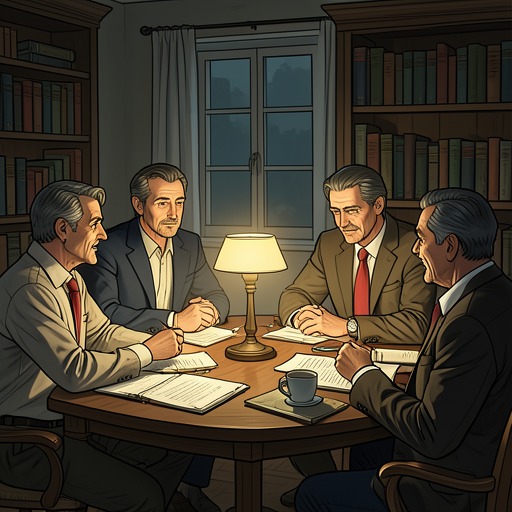
Liesel initially misunderstands the speaker’s academic phrasing and asks whether the danger is past. The address does not offer reassurance. Its voice, first marked by a pause and then by a sudden catch of emotion and revulsion, describes people digging trenches and trying on gas masks because of a quarrel in a faraway country. The distance in the phrase is thus set against immediate preparations for danger: the crisis may be framed as remote by the speaker, but its consequences are already being anticipated on the ground.
The broadcast proceeds to argue that a dispute already settled in principle should not become a war. The speaker acknowledges that the Czech government cannot accept the terms put before it in the German memorandum, yet presents further time and agreement as means of securing a fair transfer of territory. He invokes his talks with Hitler and claims to have done all one man can do to compose the quarrel. The conciliatory register makes the address’s political implication sharper: the proposed transfer is described as an arrangement to be managed, while the country and its population are the objects of that arrangement.
The phrase becomes personal
Hana gives a cry of disbelief as the address continues. When the broadcast says that sympathy for a small nation cannot in every circumstance commit the British Empire to war, and that any war must be fought for larger issues, Viktor turns off the radio. Hana answers with the phrase’s human consequence: “That’s us,” she says, identifying herself and those around her with the people the speaker has rendered distant and negligible. She is in tears; Oskar pats her shoulder, but cannot stop them.
The phrase and Hana’s response establish a contrast between political abstraction and lived proximity. The broadcast speaks of unknown people and a small issue; Hana hears a judgment about her own country and its people. The gap is not simply between nations that know one another and those that do not. It is between the language used to make a crisis seem peripheral and the people who must inhabit its consequences.
From rhetoric to dismemberment
Immediately after the radio is turned off, the narrative shifts from the address’s careful argument to an image of bodily violence. It compares two ways of dismembering a body: the cool, calculated work of a surgeon and the frenzied hacking of a mad axeman. The methods differ, but the result does not. The image reframes the diplomatic language of territory and agreement as the cutting apart of a country.
That autumn, the Great Powers assist in the country’s dismemberment. The Czechoslovak army stands down as German troops enter Eger, Karlsbad, Teplitz, and Liberec; Poland takes part of Czech Silesia, and Hungary takes parts farther east. The sequence gives concrete historical shape to Hana’s recognition. The people called unknown are not peripheral to the story: they are the population whose country is being divided while outside powers witness and enable the process.
Narrative significance
The expression recurs in Hana’s declaration that the people being discussed are “us,” turning a phrase of political distance into an accusation of abandonment. Its force depends on the conflict between the address’s language of sympathy and its decision not to treat the fate of the small nation as sufficient reason for war. The subsequent image of dismemberment carries that conflict out of the radio’s abstract language and into a brutal physical metaphor.
The scene moves from listening, to Hana’s tears, to the narrative’s account of territorial division. That progression makes the phrase more than a memorable formulation: it is the hinge between a public argument about what counts as a larger issue and the intimate recognition that the supposedly faraway people are the people in the room.